
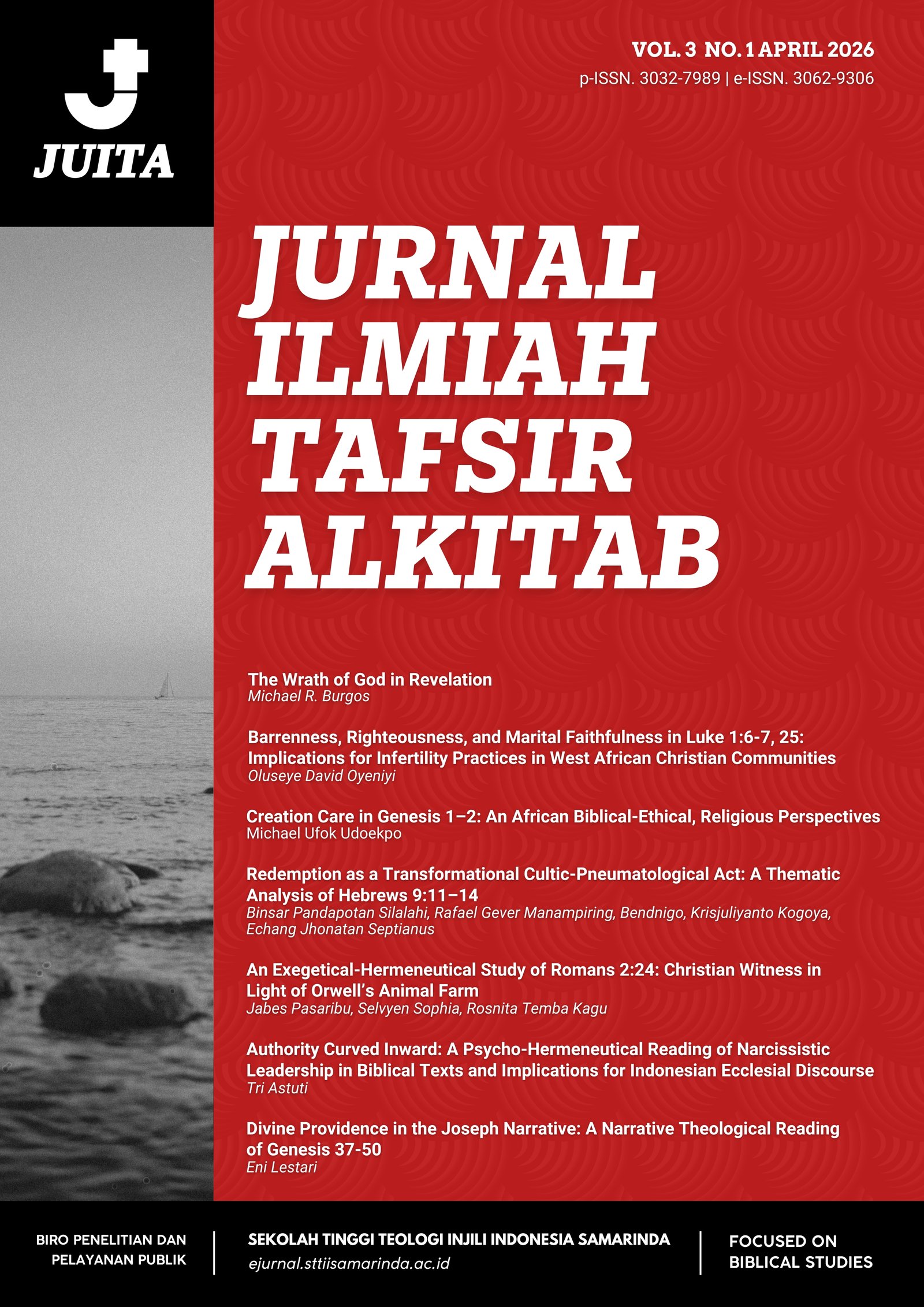
Redemption as a Transformational Cultic-Pneumatological Act: A Thematic Analysis of Hebrews 9:11–14
DOI:
https://doi.org/10.69668/juita.v3i1.194Keywords:
Redemption, Hebrews 9:11-14, Systematic Theology, Thematic AnalysisAbstract
This study addresses the tendency toward fragmentation in the study of Hebrews 9:11–14, where cultic, pneumatological, and existential approaches have been developed separately, resulting in an inadequate explanation of the relationship between Christ’s actions and the effect of sanctification. This study aims to formulate an integrative model of atonement through thematic analysis within a systematic theological framework, using exegetical examination as an analytical tool. The novelty of this study lies in the formulation of a relational model that integrates blood, the Spirit, and the purification of the conscience into a single coherent conceptual structure. The results of the study show that redemption in Hebrews 9:11–14 is structured as a cultic-pneumatological act that produces ontological transformation. Its contribution clarifies the reading of the text and provides a conceptual foundation for the development of a soteriology that integrates the legal, cultic, and transformational dimensions.
Downloads
References
Attridge, H. W. (1989). The Epistle to the Hebrews: A Commentary on the Epistle to the Hebrews. Fortress Press.
Bauer’s, W., & Danker, F. W. (2000). A Greek-English Lexicon Of The New Testament And Other Early Christian Literature (Third Edition). The University Of Chicago Press.
Bruce, F. F. (2012). The Epistle to the Hebrews. William B. Eerdmans Publishing Company.
Cockerill, G. L. (2012). The New International Commentary on the New Testament: The Epistle To The Hebrews. William B. Eerdmans Publishing Company.
Coetsee, A. J. (2022). “Through the Eternal Spirit” (Heb 9:14): The Arguments for and Implications of Interpreting the Phrase as a Reference to the Holy Spirit. In Troubling Texts in the New Testament: Essays in Honour of Rob van Houwelingen (pp. 323–344). Peeters Publishers. https://digital.casalini.it/9789042948495
deSilva, D. A. (2000). Perseverance In Gratitude: A Socio-Rhetorical Commentary on the Epistle “to the Hebrews.” William B. Eerdmans Publishing Company.
deSilva, D. A. (2004). An Introduction To The New Testament: Context, Methods & Ministry Formation (Second Edition). InterVarsity Press.
Eberhart, C. A., & Schweitzer, D. (2019). The Unique Sacrifice of Christ According to Hebrews 9: A Study in Theological Creativity. Religions, 10(1), 1–14. https://doi.org/10.3390/rel10010047
Ellingworth, P. (1993). The New International Greek Testament Commentary: The Epistle to the Hebrews. William B. Eerdmans Publishing Company.
Fee, G. D. (2011). New Testament Exegesis: A Handbook For Student and Pastors (Edisi Ketiga). Literatur SAAT.
Guthrie, G. H. (1998). The NIV Application Commentary Hebrews: Bringing The Ancient Message Of The Bible Into Your World. Zondervan.
Hayes, J. H., & Holladay, C. R. (2007). Biblical Exegesis: A Beginner’s Handbook (Third Edition). Westminster John Knox Press.
Jamieson, R. B. (2016). Hebrews 9.23: Cult Inauguration, Yom Kippur and the Cleansing of the Heavenly Tabernacle. New Testament Studies, 62(4), 569–587. https://doi.org/10.1017/S0028688516000199
Johnson, L. T. (2006). The New Testament Library: Hebrews A Commentary. Westminster John Knox Press.
Koester, C. R. (2001). Hebrews: A New Translation With Introduction And Commentary. The Anchor Bible, Doubleday.
Lane, W. L. (1991). Word Biblical Commentary: Hebrews 9-13 (Vol. 47B). Word Books, Publisher.
Lukin, V. (2024). Why did Jesus suffer “outside the gates” and not “outside the camp”? The theological significance of the two place-spaces in Hebrews. 7–51.
Mariano, G. J. (2024). Theodicy of Sacrifice and High Priestly Ministry of Christ in Hebrews 9: 11-28: A Call for Faithfulness and Perseverance. 11(7), 1619–1630. https://doi.org/10.35974/isc.v11i7.3406
McIver, R. K. (2016). Goats, Calves, Bulls, and Heifer’s Ashes: Heb 9: 12–13 and the Day of Atonement in the Epistle to the Hebrews. https://research.avondale.edu.au/items/93af7199-d745-4540-869e-c1a0768ed548
Moffitt, D. M. (2013). Atonement and the Logic of Resurrection in the Epistle to the Hebrews. Brill.
Mullins, S. (2016). Typology, Tabernacle and Tradition: A History of Interpretation of Hebrews 9: 11-14 [Honors Thesis]. University of Dayton.
New Advent. (n.d.). Homilies on Hebrews (Chrysostom). New Advent. https://doi.org/https://www.newadvent.org/fathers/240215.htm
O’Brien, P. T. (2010). The Letter to the Hebrews. William B. Eerdmans Publishing Company.
Sewakpo, H. (2016). An Interpretation of Christ as the Sacrifice in Hebrews 9: 26 to a Holistic Relationship with God. Int’l J. Soc. Sci. Stud., 4, 26.
Silva, M. (2014). New International Dictionary Of New Testament Theology And Exegesis: One. Zondervan.
Wallace, D. B. (1996). Greek Grammar Beyond The Basics: An Exegetical Syntax of the New Testament With Scripture, Subject, and Greek Word Indexes. Zondervan Publishing House.
Westfall, C. L. (2005). A Discourse Analysis Of The Letter To The Hebrews: The Relationship between Form and Meaning. T&T Clark.
Downloads
Published
How to Cite
Issue
Section
License
Copyright (c) 2026 The Author(s)

This work is licensed under a Creative Commons Attribution 4.0 International License.