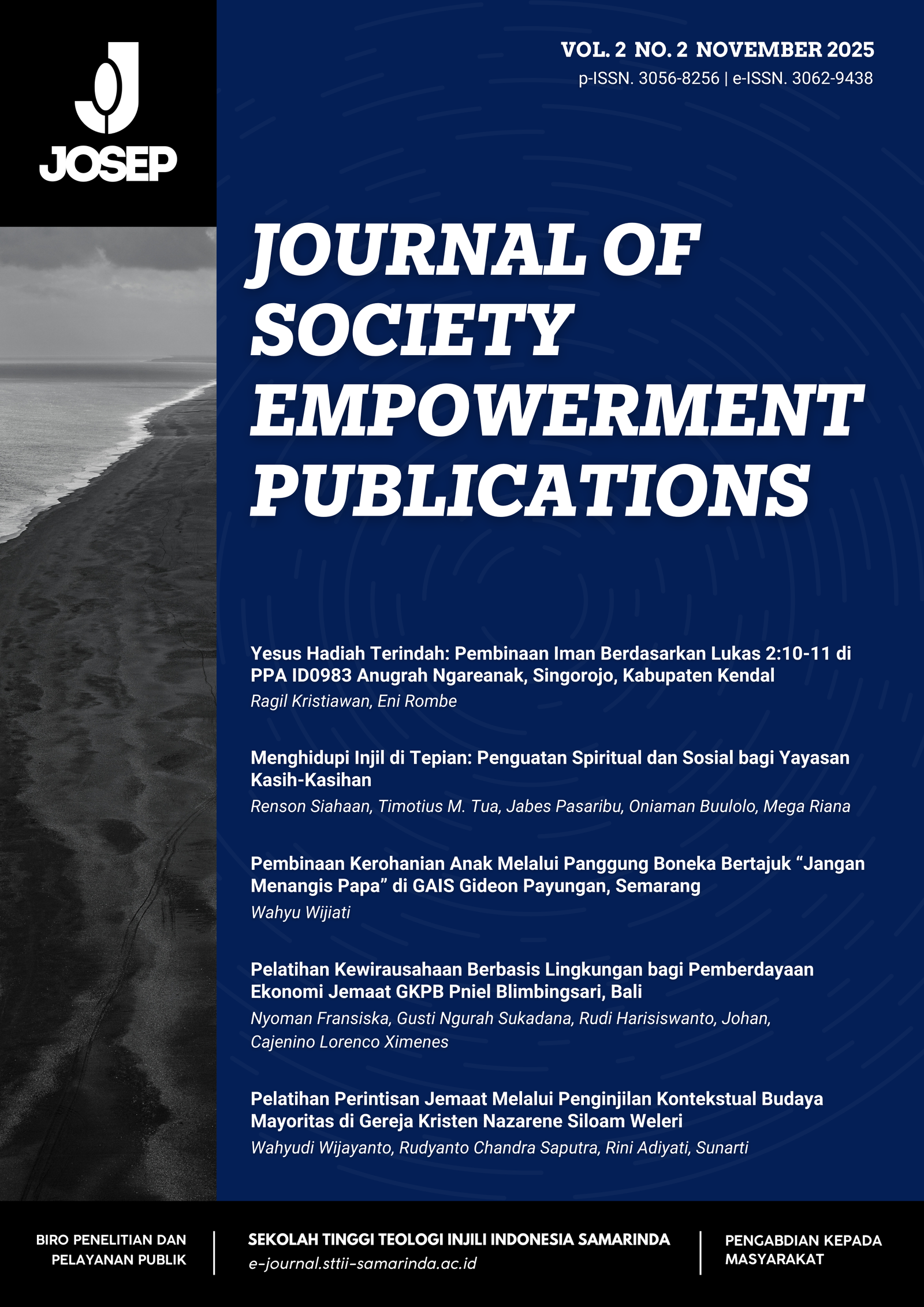
Pelatihan Kewirausahaan Berbasis Lingkungan bagi Pemberdayaan Ekonomi Jemaat GKPB Pniel Blimbingsari, Bali
DOI:
https://doi.org/10.69668/josep.v2i2.157Keywords:
entrepreneurship, environment, economy, agricultureAbstract
Understanding the Economy of God's Kingdom as an alternative paradigm that integrates economic principles with biblical values. The critical context of the Pniel GKPB Blimbingsari congregation with a 30% decline in income, large but underutilized land potential, and limited knowledge of sustainable land management. Dependence on conventional production practices, limited market access, lack of business management knowledge, and agricultural practices that do not maintain environmental sustainability. The Environment-Based Entrepreneurship Service Program (KEKAL) integrates organic farming techniques (maggot fertilizer and fermented feed) with the spiritual and ethical values of the Kingdom of God according to Genesis 2:15. The method used is a mixture of qualitative and quantitative. The results of this service program showed a significant increase in the economic empowerment of the Kingdom of God (PEKA) by 50%, eco-theological behavior (PEKO) by 43.45%, with practical achievements in the form of 80% of participants producing their own organic fertilizer, spiritual transformation reaching 70%, and the conclusion that KEKAL is effective as a transformative entrepreneurship model that restores the relationship between humans, creation, and God.
References
Abdiel Putra, Kapuangan, dkk. (2025). Strategi Gereja Toraja Dalam Mendorong Pertumbuhan UMKM Melalui Momentum 110 Tahun IMT Sebagai Dasar Pemberdayaan. JEBI: Jurnal Ekonomi Dan Bisnis, 3(4), 1055–1065.
Aria Eka Agustina Abdullah, Nila Malikhah, Savina Nur Lailiyah, & Mochammad Isa Anshori. (2025). Eco-Leadership: Peran Pemimpin dalam Mewujudkan Ekonomi Berkelanjutan dan Ramah Lingkungan. Jurnal Riset Rumpun Ilmu Ekonomi, 4(1), 308–320. https://doi.org/10.55606/jurrie.v4i1.5551
Beech, C. (2018). Faith-based social entrepreneurship: The integration of faith and business for sustainable social impact. ProQuest LLC, 164.
Cahyaningsih, N. K. M. A., & Santhyasa, I. K. G. (2021). Strategi Pengembangan Desa Wisata Blimbingsari Berbasis Masyarakat Di Kabupaten Jembrana, Bali. Pranatacara Bhumandala: Jurnal Riset Planologi, 2(2), 147–161. https://doi.org/10.32795/pranatacara_bhumandala.v2i2.2233
Cassandra Laurensia Lolowang, Beni Chandra Purba, & Budi Kelana. (2023). Dinamika Kepemimpinan Pastoral dalam Konteks Manajemen Gereja Modern. JUITAK : Jurnal Ilmiah Teologi Dan Pendidikan Kristen, 1(4), 40–53. https://doi.org/10.61404/juitak.v1i4.190
Erlin Kurniati, & Ayu Sukma Wardhani. (2025). Dari Ladang ke Pasar: Mengurai Jejak Ekonomi Pertanian di Jember. Jurnal Bersama Ilmu Ekonomi (EKONOM), 1(1), 64–73. https://doi.org/10.55123/ekonom.v1i1.56
Jonathan Pattiasina dan Heintje B. Kobstan. (2024). Ekonomi Kerajaan Allah. ANDI.
Junaedi, I. W. R. (2013). Blimbingsari: Modal Sosial Dan Peran Pemda Dalam Pembangunan Ekonomi Di Kabupaten Jembrana, Bali. Jurnal Transformatif Unkriswina, 12(1), 65–83. https://ojs.unkriswina.ac.id/index.php/transformatif/article/view/96
Khairani, L. (2024). Pengembangan Model Bisnis Ramah Lingkungan: Studi Kasus Perusahaan XYZ. Circle Archive, 1–13. https://circle-archive.com/index.php/carc/article/view/221
Kinanti Indah Safitri, S Abdoellah, O., & Gunawan, B. (2024). Komersialisasi Pertanian Kota Dalam Tekanan Pasar Perspektif Ekologi Politik. SUMUR- Jurnal Sosial Humaniora, 2(2), 65–81. https://doi.org/10.58794/sumur.v2i2.954
Komul, Y. D., Selanno, F. M., & Tetelay, F. F. (2023). Pemberdayaan Pemuda Gereja Melalui Pelatihan Pertanian Hortikultura di Wanasa Desa Tehoru Kabupaten Maluku Tengah. Kapas: Kumpulan Artikel Pengabdian Masyarakat, 2(2). https://doi.org/10.30998/ks.v2i2.2032
Made Gunaraksawati-ten Veen. (2009). Teologi Kewirausahaan, Konsep dan Praktik Bisnis Gereja Kristen Protestan di Bali. Yayasan Taman Pusaka Kristen Indonesia.
Nasution, A. F. I., & Marliyah, M. (2022). Strategic Analysis of the North Sumatra Regional Development Planning Agency in the Development of Bumdes and the Village Economy. Jurnal Fokus Manajemen, 2(1), 71–78. https://doi.org/10.37676/jfm.v2i1.2158
Paulina, S. (2023). Peran Gereja Terhadap Ekonomi Jemaat Dan Upaya Gereja Dalam Meningkatkan Pemberdayaan Ekonomi Jemaat. Jurnal Pendidikan Sosial Dan Humaniora, 2(1), 12216–12225.
Pravitasari, aufa G., & Nugraheni, N. (2023). Transformasi Pendidikan Menuju Konservasi Berkelanjutan: Membangun Kesadaran Lingkungan dan Kepedulian Generasi Mendatang. Jurnal Penelitian Ilmu-Ilmu Sosial, 1(1), 6–11.
Pujiriyani, D. W., Sugiasih, S., & Sutaryono, S. (2024). Membandingkan Keberhasilan Pengembangan Food Estate Berbasis Reforma Agraria Di Desa Karangwangi, Mekarmukti dan Desa Sukawargi, Cisurupan, Kabupaten Garut. Ganaya : Jurnal Ilmu Sosial Dan Humaniora, 7(4), 103–114. https://doi.org/10.37329/ganaya.v7i4.3480
Yuli Indri Hapsari. (2025). Entrepreneurship Kristen sebagai Model Inovasi Teologis untuk Penguatan Pelayanan Gereja. Keruxon Ton Logon: Jurnal Teologi Dan Pendidikan Agama Kristen, 2(1), 61–73.
Downloads
Published
How to Cite
Issue
Section
License
Copyright (c) 2025 The Author(s)

This work is licensed under a Creative Commons Attribution 4.0 International License.

 ENCE TOOLS