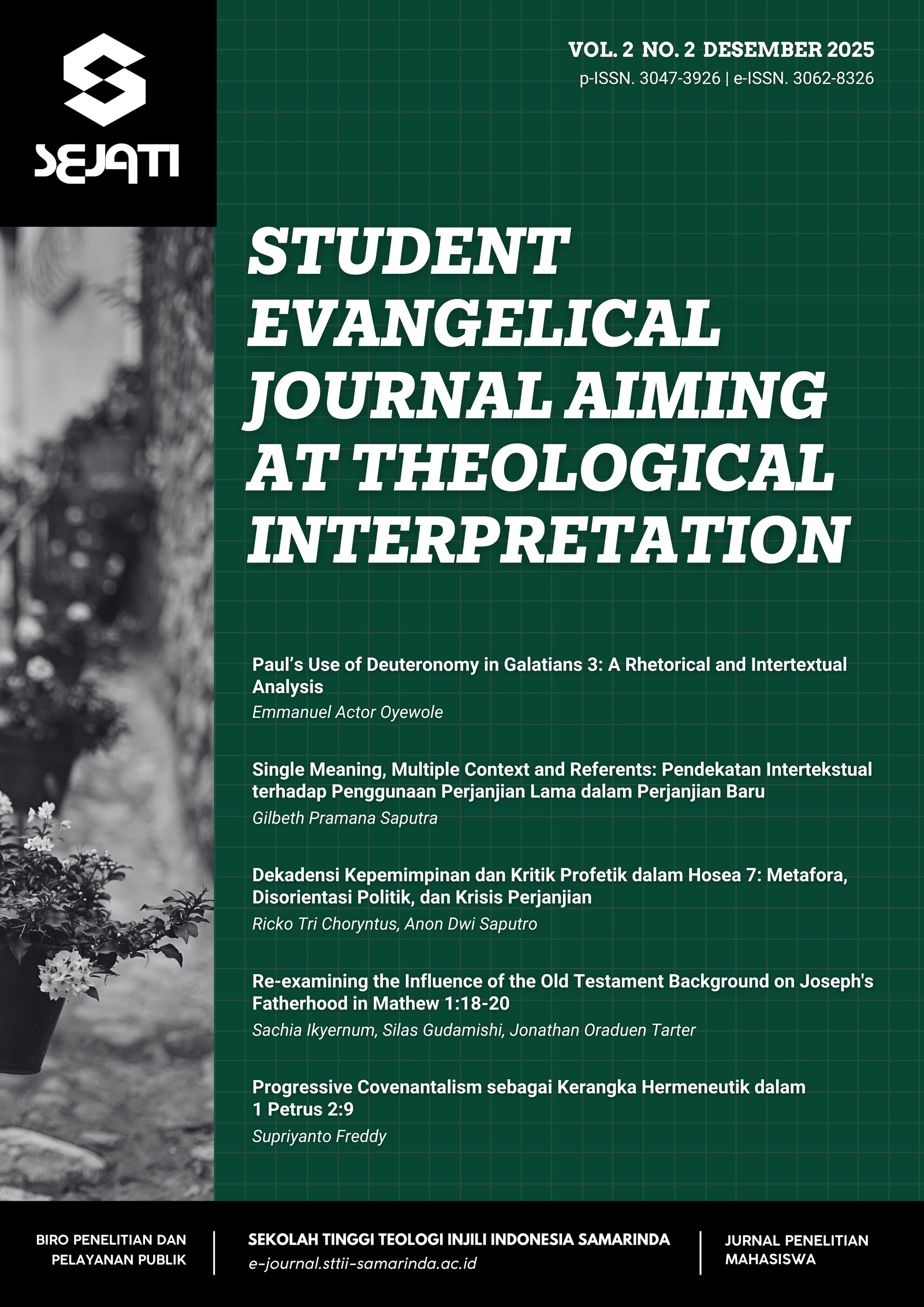
Progressive Covenantalism sebagai Jembatan Hermeneutis: Rekonsiliasi Dispensasionalisme dan Teologi Perjanjian dalam Penafsiran 1 Petrus 29
DOI:
https://doi.org/10.69668/sejati.v2i2.101Kata Kunci:
Progressive Covenantalism, 1 Petrus 2:9, Israel dan Gereja, HermeneutikAbstrak
Penelitian ini mengkaji Progressive Covenantalism sebagai kerangka hermeneutik alternatif untuk memahami relasi antara Israel dan gereja, dengan fokus pada 1 Petrus 2:9. Sebagai respons terhadap perbedaan tajam antara Dispensasionalisme dan Teologi Perjanjian, paradigma ini melihat gereja sebagai penggenapan progresif janji Allah dalam Kristus, sambil tetap mengakui peran khas Israel. Pendekatan kualitatif digunakan melalui analisis teks Yunani, studi intertekstual dengan Perjanjian Lama, dan perbandingan literatur utama dari ketiga pendekatan teologis. Temuan menunjukkan bahwa Progressive Covenantalism lebih mampu mempertahankan kesinambungan historis-redemptif tanpa meniadakan panggilan Israel. Pendekatan ini menawarkan implikasi penting bagi pengembangan eklesiologi dan wacana teologis di Indonesia. Kontribusi utama terletak pada pengenalan Progressive Covenantalism dalam konteks teologi Indonesia dan tawaran model penafsiran yang seimbang terhadap 1 Petrus 2:9.
Referensi
Beale, G. K. (2012). Handbook on the New Testament Use the Old Testament: Exegesis and Interpretation. Baker Academic.
Blaising, C. A., & Bock, D. L. (1993). Progressive Dispensationalism. Baker Academic.
Fruchtenbaum, A. G. (2005). Israelology: The Missing Link in Systematic Theology. Ariel Ministries.
Gentry, P. J., & Wellum, S. J. (2016). Kingdom through Covenant: A Biblical-Theological Understanding of the Covenants (2nd ed.). Crossway.
Gentry, P. J., & Wellum, S. J. (2018). Kingdom through Covenant: A Biblical-Theological Understanding of the Covenants (2nd ed.). Crossway.
Grace Yuspratiwi, E. A. M. (2025). Umat Allah: Israel Dan Gereja. Jurnal Silih Asuh: Teologi Dan Misi, 2(1), 91–102. https://doi.org/10.54765/silihasuh.v2i1.80
Greenberg, S. B. (2023). Between Covenant and Contract: Jewish Political Thought and Contemporary Political Theory. Religions, 14(11), 1352. https://doi.org/10.3390/rel14111352
Hays, R. B. (2014). Reading Backward: Figural Christology and the Fourfold Gospel Witness. Baylor University Press.
Horton, M. (2006). God of Promise: Introducing Covenant Theology. Baker Books.
Horton, M. S. (2011). The Christian Faith: A Systematic Theology for Pilgrims on the Way. Zondervan.
Kgatle, M. S. (2024). Pentecostalism and Covenantalism: Towards a Pneumatological Covenant Theology of Dealing with Adversity. E-Journal of Religious and Theological Studies, 352–361. https://doi.org/10.38159/erats.202410103
L M, Y. (2021). Problematika Teologis Hubungan Istilah Gereja dan Israel. BIA’: Jurnal Teologi Dan Pendidikan Kristen Kontekstual, 4(1), 37–51. https://doi.org/10.34307/b.v4i1.119
Mark, Y. (2025). Messianic Jews and Palestinian Christians’ Conflicting Theologies of the Land: Is Reconciliatory Theological Dialogue Possible? Theological Reflections: Eastern European Journal of Theology, 23(1), 90–111. https://doi.org/10.29357/2789-1577.2025.23.1.5
Nestle-Aland. (2012). Novum Testamentum Graece (B. M. M. Barbara and Kurt Aland, Johannes Karavidopoulos, Carlo M. Martini (Ed.); Revised Ed). Institute for New Testament Textual Research.
Pacheco, C. C. (2017). The Relationship of Law and Grace in the Hermeneutics of New Covenant Theology. https://doi.org/10.32597/theses/100/
Parker, B. E. (2017). The Church as the Renewed Israel in Christ : A Study of 1 Peter 2:4-10. The Southern Baptist Journal of Theology, 21(3), 41–52.
Popoola, O., & Salurante, T. (2023). Covenant Violation as A Pathway For Interpreting The Gospel: An Engagement With Schilder and The Yoruba Thought. Jurnal Jaffray, 21(1), 37. https://doi.org/10.25278/jj.v21i1.826
Ryrie, C. C. (2007). Dispensationalism. Moody Publishers.
Schreiner, T. R. (2003). 1, 2 Peter, Jude. B&H Publishing Group.
Sweetnam, M. S. (2010). Defining dispensationalism: A cultural studies perspective. Journal of Religious History, 34(2), 191–212. https://doi.org/10.1111/j.1467-9809.2010.00862.x
Tuck Seon Chung. (2020). The Irrevocable View of the Phinehasian Covenant in Light of the Davidic Covenant. Jurnal Amanat Agung, 15(2), 179–202. https://doi.org/10.47754/jaa.v15i2.382
Vorster, J. M. (2016). Marriage and family in view of the doctrine of the covenant. HTS Teologiese Studies / Theological Studies, 72(3), 1–8. https://doi.org/10.4102/hts.v72i3.3218
Vorster, K. (2017). Kingdom, covenant, and human rights. In Die Skriflig/In Luce Verbi, 51(2), 1–8. https://doi.org/10.4102/ids.v51i2.2257
Walvoord, J. F. (1988). The Nations, Israel and the Church in Prophecy. Zondervan.
Wellum, S. J., & Parker, B. E. (Eds.). (2014). Progressive Covenantalism: Charting a Course between Dispensational and Covenantal Theologies. B&H Academic.
Wellum, S. J., & Parker, B. E. (2016). Progressive Covenantalism: Charting a Mediating Position Between
Dispensational and Covenantal Theologies (S. J. Wellum & B. E. Parker (Eds.)). B&H Academic.
Williams, S. (2022). Jesus is Coming Soon. Vanguard Journal of Theology & Ministry, 1(2), 28–39. https://doi.org/10.29173/vjtm49
Unduhan
Diterbitkan
Cara Mengutip
Terbitan
Bagian
Lisensi
Hak Cipta (c) 2025 Supriyanto Freddy

Artikel ini berlisensi Creative Commons Attribution 4.0 International License.

 ENCE TOOLS