
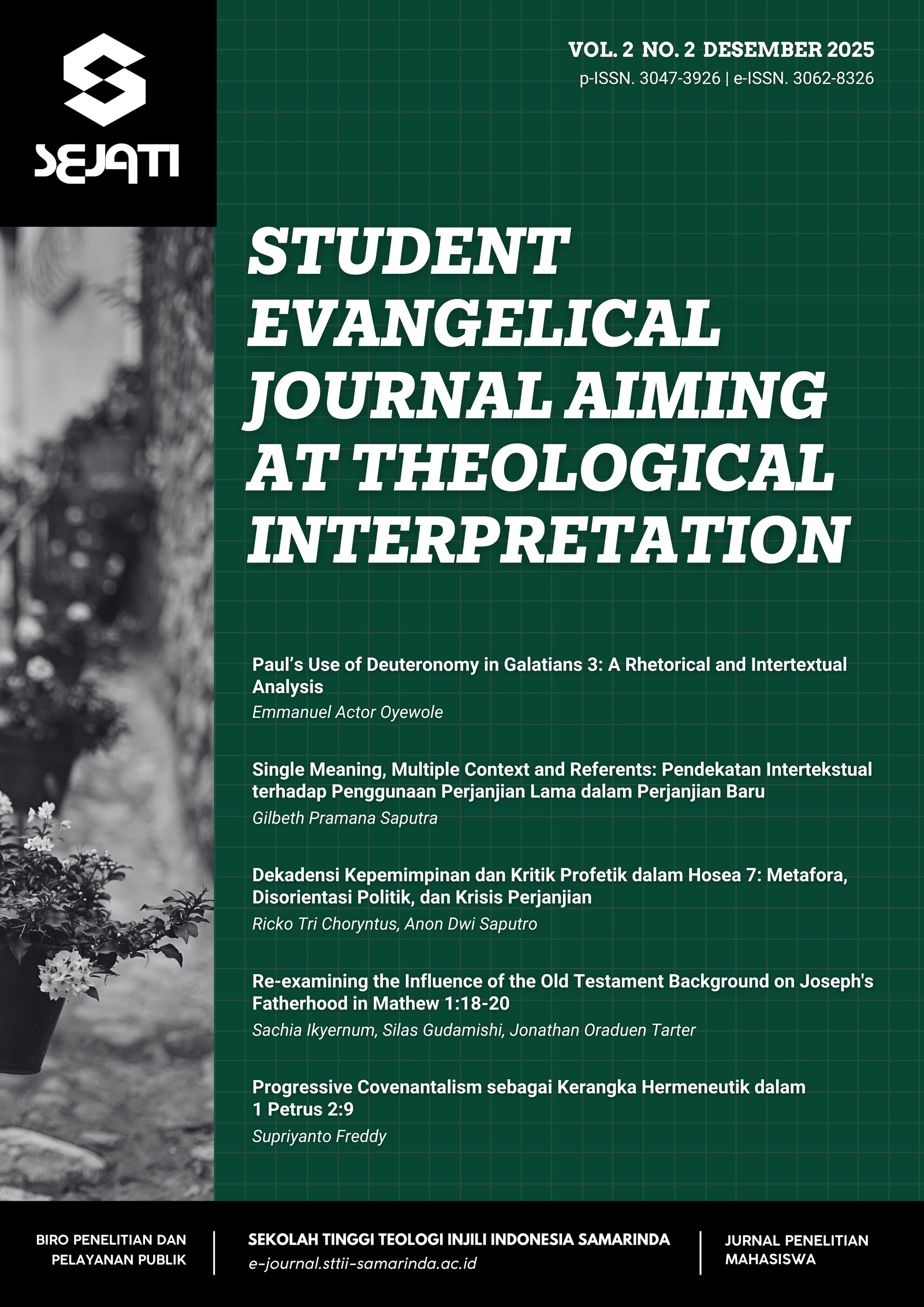
Dekadensi Kepemimpinan dan Kritik Profetik dalam Hosea 7: Metafora, Disorientasi Politik, dan Krisis Perjanjian
DOI:
https://doi.org/10.69668/sejati.v2i2.146Keywords:
Hosea 7, Prophetic Metaphor, Leadership Failure, Covenant Theology, Biblical LeadershipAbstract
This article re-examines Hosea 7 as a sustained prophetic critique of Israel’s political and spiritual leadership during the eighth century BCE. While previous scholarship has tended to treat Hosea 7 primarily as a collection of poetic metaphors or moral denunciations, this study argues that the chapter functions as a coherent theological discourse exposing systemic leadership failure rooted in covenantal infidelity. Employing a metaphorical-theological approach integrated with historical and literary analysis, this research demonstrates that the metaphors of the oven, the unturned cake, the gray hair, the foolish dove, and the deceitful bow collectively construct a multidimensional critique of moral decay, political opportunism, and spiritual disorientation among Israel’s leaders. The findings highlight that leadership collapse in Hosea 7 is fundamentally theological rather than merely political, arising from the loss of prophetic ethics and loyalty to YHWH. By extending this prophetic critique to contemporary Christian leadership, the study contributes to biblical leadership studies by proposing a theologically grounded evaluative framework that emphasizes covenantal integrity, prophetic accountability, and God-centered authority as essential markers of faithful leadership.
References
Alexander George Nicolaides and A. Nicolaides. (2024). Renewing the Covenant: Insights for Right and Just Living from the Book of Hosea. Pharos Journal of Theology, 106(106.1), 1–16. https://doi.org/10.46222/pharosjot.106.21
Andersen, F. I., & David Noel Freedman. (1980). Hosea: A New Translation with Introduction and Commentary, Anchor Bible 24. Doubleday.
Bullock, C. H. (2014). Kitab Nabi-nabi Perjanjian Lama. Gandum Mas.
Calvin, J. (n.d.). Commentary on Hosea: Commentary on the Twelve Minor Prophets (T. J. Owen (Ed.)).
Daniel I. Block. (2013). The Gods of the Nations: Studies in Ancient Near Eastern National Theology. Baker Academic.
Douglas Stuart. (1987). Hosea-Jonah, Word Biblical Commentary Vol. 31. Word Books.
Eric J. Tully. (2018). Hosea: A Handbook on the Hebrew Text. Baylor University Press.
Faigenbaum-Golovin, S., Shaus, A., Sober, B., Turkel, E., Piasetzky, E., & Finkelstein, I. (2020). Algorithmic handwriting analysis of the Samaria inscriptions illuminates bureaucratic apparatus in biblical Israel. PLoS ONE, 15(1), 1–13. https://doi.org/10.1371/journal.pone.0227452
Finkelstein, I. (2020a). Jeroboam II’s Temples,” Zeitschrift für die Alttestamentliche Wissenschaft. 132(2).
Finkelstein, I. (2020b). Jeroboam II’s Temples. Zeitschrift Fur Die Alttestamentliche Wissenschaft, 132(2), 250–265. https://doi.org/10.1515/zaw-2020-2004
Francis Brown, & S. R. Driver, C. A. B. (1907). A Hebrew and English Lexicon of the Old Testament. Clarendon Press.
Francis Landy. (1989). Paradoxes of Paradise: Identity and Difference in the Song of Songs, JSOTSup 170. JSOT Press.
Hans Walter Wolff. (1974). Hosea: A Commentary on the Book of the Prophet Hosea, Hermeneia. Fortress Press.
Holmquist, D. B. (2017). Hosea 7:1-16 and Destructive Leadership Theory: An Exegetical Study. Emergent Religious Pluralisms, 10(1), 126–137.
James L. Mays. (1969). Hosea: A Commentary, Old Testament Library. Westminster Press.
James Limburg. (1988). Hosea-Micah, Interpretation Commentary Series. John Knox Press.
James Limburg. (2011). Hosea-Jonah. Westminster John Knox Press.
John C. Maxwell. (2018). Developing the Leader Within You 2.0. Thomas Nelson.
Miller, J. M., & Hayes, J. H. (1986). A History of Ancient Israel and Judah. Westminster Press.
Muhlhan, B. (2013). A Determined and Subjective Love: Agreeing with Luther’s Evangelical Reading of Hosea 2. New Blackfriars, 94(1051), 340–357. https://doi.org/10.1111/j.1741-2005.2012.01501.x
Pakpahan, G. K. R., & Pantan, F. (2022). Destructive Leadership in State and Religion: An Exegetical Study of Hosea 7:1-16. Old Testament Essays, 35(2), 329–347. https://doi.org/10.17159/2312-3621/2022/v35n2a11
Paul Ricoeur. (1978). The Rule of Metaphor: Multi-Disciplinary Studies of the Creation of Meaning in Language. Routledge.
Robert Alter. (2011). The Art of Biblical Narrative. Basic Books.
Saputro, A. D. (2023). Eksplorasi Metafora Keburukan Israel Berdasarkan Hosea 7 Sebagai Retrospeksi Spiritualitas Umat. Predica Verbum: Jurnal Teologi Dan Misi, 3(1), 1–13. https://doi.org/10.51591/predicaverbum.v3i1.53
W. Wolff. (1974). Hosea, Hermeneia. Fortress Press.
Walton, A. E. H. & J. H. (2013). Survei Perjanjian Lama. Gandum Mas.
Willem A VanGemeren. (2007). Penginterpretasian Kitab Para Nabi (Interpreting the Prophetic Word). (I. Tjulianto (Ed.)). Momentum Christian Literature.
Zaluchu, S. E. (2021). Metode Penelitian Di Dalam Manuskrip Jurnal Ilmiah Keagamaan. Jurnal Teologi Berita Hidup, 3(2).
Downloads
Published
How to Cite
Issue
Section
License
Copyright (c) 2025 Ricko Tri Choryntus, Anon Dwi Saputro

This work is licensed under a Creative Commons Attribution 4.0 International License.

 ENCE TOOLS